
FAQ
FAQ
Which species of tree/wood do I cut for Shiitake, Oyster, Lion’s Mane?
For Shiitake:
Superior – white & red oak; hard maples especially sugar maple
Also Recommended – ironwood; beech; alder
Not Recommended – Manitoba maple & soft maples; fruitwood; ash; evergreens including pines; cedar; balsam
Note: Shiitake will also grow indoors on sawdust as kits or grow blocks. You can find information/parameters for indoor cultivation in the books Growing Gourmet and Medicinal Mushrooms and in The Mushroom Cultivator both by Paul Stemets. Oysters are also cultivated indoors on hardwood sawdust.
For Oyster:
Superior – aspen; yellow poplar; Manitoba maple/soft maple; alder; cottonwood & willows
Also Recommended – hackberry; mulberry
Not Recommended – hardwoods such as Beech, ash, and hard maples; evergreens
including pines, cedar and balsam
Note: Oysters will also grow indoors on straw and coffee grounds and other
agricultural by-products. You can find information/parameters for this method of
cultivation in the books Growing Gourmet and Medicinal Mushrooms and in The
Mushroom Cultivator both by Paul Stemets. Oysters are also cultivated indoors on hardwood sawdust.
For Lion’s Mane:
Superior – Oak; Beech; sugar maple and other hard maples
Also Recommended – walnut and elm and similar broadleaf hardwoods
Not Recommended – ‘paper barked’ trees such as birch and alder; no evergreens
None of the ‘wood’ mushrooms will grow on evergreens and none will grow on Walnut.
Fruitwood is not recommended for any of the ‘wood’ mushrooms. All of these species of
wood contain various anti-fungal substances/properties.
When should I cut my logs?
Timing matters. It is recommended to cut logs when the tree is dormant; winter is best
because the bark is tight on the log. In northern climatic zones/continental climate you
can cut logs up until end of March. It is advisable to leave logs rest for at least 1 month
after cutting and before inoculation to allow naturally occurring secondary substances—such as anti-fungal substances—to break down so that they won’t inhibit the mushroom
mycelium from colonizing the sapwood.
Where should I keep the logs after felling and where do I locate logs?
Location matters. After felling and prior to inoculation you can leave the cut trees
resting in place in the ‘forest’; cover with cedar boughs or burlap to protect from direct
sunlight. Allow snowfall to cover them. Or you can remove the upper branches and then
cut the tree trunk into 4’ sections/logs; stack on a skid or on top of the branches or other
logs or wood planks to keep them off the ground. Leaving trunks intact until inoculation
preserves moisture inside. Once trees are cut into 4’ sections stack in a low profile
configuration such as a lean-to arrangement or in a crib style arrangement not more than
3 logs high in a protected location until inoculation. Cover with burlap or other porous
material to protect from direct sunlight but to allow rainfall to soak them and to allow
snow to cover them. It is important to keep logs off the ground and to protect them from direct sunlight and drying winds. Choose the location for the spawn run laying ‘yard’
accordingly. You don’t want to move the logs more than is necessary; inoculate them
near the eventual laying yard.
Once inoculated the logs should be stacked and located in a shaded and protected area
for the spawn run. When choosing the location for your spawn run laying yard consider
elevation, slope, and aspect as well as access to water. A hilltop is not a good location
because it is too windy; valley bottoms or low depressions may be too wet in the spring
and air may be stagnant. If locating the logs on a slope the direction the slope faces is
important. The following description is from Growing Shiitake Mushrooms in a
Continental Climate:
“South and southwest slopes are much warmer than north or east slopes. North
slopes will remain cooler much later into the spring than south slopes. Layng
yards on slopes must be carefully chosen to maximize the benefits of early spring
warming and good air circulation.”
How do I stack the logs for the spawn run?
Stacking pattern matters. If you intend to cut the trees and leave them in a wooded
area until inoculation you can cut off the top branches and roll the trunks onto the
branches to keep them off the ground. Allow snow to cover them. Keep in mind that
you will have to cut the trunks into 4’ sections and move them in the spring to the
inoculation site; best to locate the inoculation site near the laying yard to avoid having
the move heavy logs more than necessary. Also keep in mind that once the logs are
inoculated, they must be stacked for the spawn run where they will remain until the
following spring. Choose a stacking pattern that allows rainfall to reach all the logs in the
stack and that allows airflow around each log. Stack logs off the ground in an
arrangement that allows air flow around all the logs. Do not stack in a dead pile.
Stack logs on the skid in a crib style pile not more than 3 logs high. This configuration is
an efficient use of space but the logs on top of the pile are subject to drying winds and
when temperatures drop to -20C the top logs can become ‘freeze dried’ – spawn will die.
Another disadvantage of crib stacks is that the logs on or near the bottom get less
rain/water; there are ‘rain shadows’ created on lower logs and this inhibits spawn run.
The ideal configuration for northern climates is a low ‘lean to’ arrangement on a south
facing slope protected from wind and with access to water for sprinkling/soaking. The
low lean-to arrangement works both for the spawn run and for fruiting/harvesting. It is not
the most efficient use of space but consider how many logs you have, how much space
you have, and how often you will be able to move your logs (wet logs are heavy).
Where do I locate the logs and stack for harvesting following the spawn run?
Following spawn run—the spring after inoculation—logs should be configured/arranged
for fruiting and harvesting under the forest/woodlot canopy or under shade cloth.
Consider the same things as for the spawn run location—good air circulation and out of the wind; not in a stagnant swampy area and not on a hilltop. If you have chosen a good
location for your logs during the spawn run they can remain in this location for
harvesting. You have to consider how many logs you have and how much space you
have for your fruiting yard, as well as the particular physical aspects of your property—slopes, canopy cover, access to water, etc.as well as how you will move logs. If your
logs are in a lean-to arrangement in a good location during the spawn run, you can leave
them in place in this configuration.
The stacking configurations you use will depend on how many logs you have and how
efficiently you need to use space on your property. The low lean-to as described above
is not the most efficient use of space but if you don’t have too many logs it can work very
well especially on south facing slopes that are under the forest canopy. Rain can reach
all logs, logs are protected from wind, and logs are shaded.
If you have a wooded lot the logs can be stood on end leaning around standing trees in
a ‘tepee’ configuration but wait until leaf out to do this so that logs are shaded. This
arrangement allows for easy harvesting and excellent exposure to rain; keep angle of
logs fairly low.
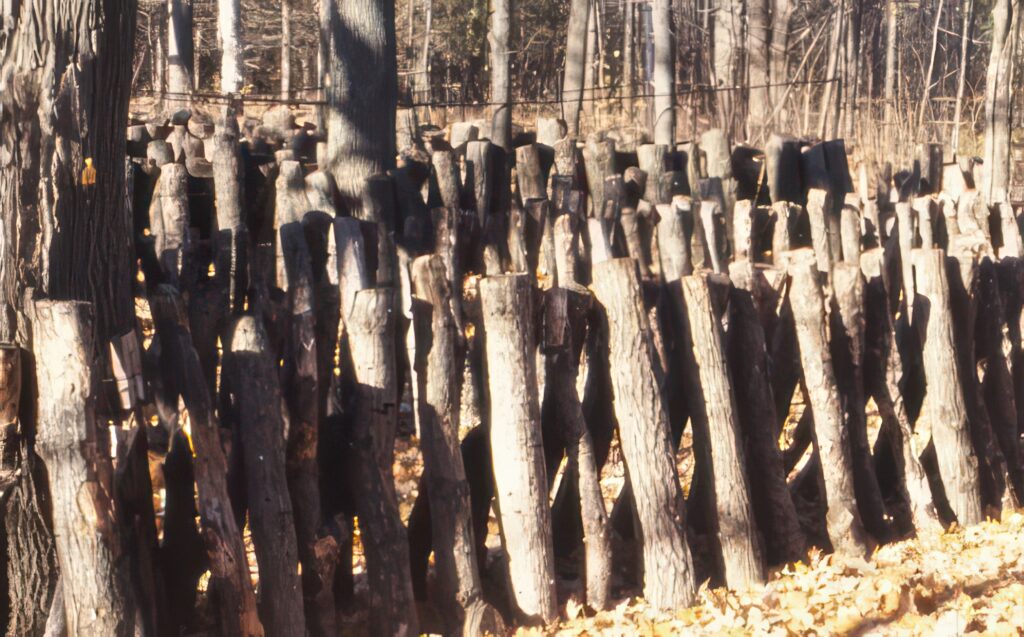
Logs can also be leaned on barbed wire strung between posts under the canopy or
under shade cloth; alternate logs on each side of the wire in an A-frame configuration;
keep the angle low.
Logs can be leaned on fixed rails about 2.5 to 3’ above the ground – 2 rails opposite
each other so that logs can be flipped from rail to rail/side to side for harvesting and to
maximize exposure to rainfall. This can be located under the canopy or under shade
cloth. Keep angle low.
Lean-to arrangements also work well, especially on south or southwest facing slopes.
Lean-to arrangements can be used both for the spawn run phase and for harvesting.
At the end of harvesting/fruiting season logs should be maintained in a low profile stack
for the winter dormant season either in a low lean-to stack or on a skid in a low crib
stack. Please refer to this document from Kozak Krawcyzk for more information.
What about moisture and when should I water my logs?
Watering logs depends on how you want to manage your logs. Throughout the spawn
run phase you can sprinkle logs for 6-8 hours during droughts. During droughts you can
also put logs directly on the ground so they can absorb moisture but restack off the
ground following drought.
For fruiting/harvesting phase you can choose to rely on natural rainfall to provoke
fruiting, or you can force fruit logs by watering soaking. This means sprinkling for 24-48
hours or submerging in water for 12-24 hours depending on log diameter. To water logs
to force them to fruit the log must be soaked for 12 to 24 hours either by submerging in a
tub (a clean garbage can works well; fill with water and leave it stand to off-gas chlorine
and then put a log in with a rock or brick on top to keep it from floating up) or by sprinkling for 24 to 48 hours. Logs must rest between fruiting/soaking for 6 to 8 weeks to allow the mycelium to digest more of the wood lignan/fibers. Do not water logs daily/weekly as you do a garden; this will encourage mold growth on the bark; bark will deteriorate and come off and this will shorten the life of your log. Logs should only be forced once they have fruited spontaneously. Logs will fruit spontaneously in early spring after the first rainfalls when temperatures are still cool. They will fruit again spontaneously in the fall after soaking rainfalls. In the hot summer logs will remain
‘dormant’ unless watered or exposed to rainfall.
To stagger production of your logs you must force them in batches so that they don’t all
fruit at the same time. Cover the logs that you want to remain dormant when it rains
(clear plastic works) and soak/sprinkle one or 2 at a time to stagger production. Uncover
the logs at other times. Don’t leave logs covered for long with plastic as it will affect bark
integrity. Uncover logs when it is not raining.
How do I place an order and what is the deadline?
It is best to place your order after you know how many logs you will be inoculating. Mark trees to cut in the summer/fall when leaves are on the tree and you can make a positive identification. Then cut in the winter months and leave outside under the forest canopy—off the ground on other logs or a skid—covered with snow until the logs can be pulled out of the forest/woodland and cut into sections ready for inoculation in the spring as described above. Our ‘deadline’ is March 15 to place an order but we will accept orders until June, however we may not be able to fill orders
placed after March 30.
When will I get my spawn?
We provide spawn for the outdoor log inoculation season in Canada which is generally from April until end of July. In the maritime provinces of British Columbia, Nova Scotia, and New Brunswick the season starts a bit sooner and lasts longer. Southern Ontario near the Great Lakes can also be included; it has a modifying influence of the lakes. In the continental provinces of Alberta, Manitoba, Saskatchewan and Northern Ontario the season is later and ends sooner. We will start shipping to the maritime/modified climate areas as early as mid April and will ship to the continental climate areas at the end of April. Be aware that you don’t want to inoculate too early in the season because this risks hard frosts and cold snaps which will kill your spawn. Ambient daytime temperatures should be consistently at 10 degrees Celsius or above and nighttime temperatures should not dip below 5 degrees Celsius to be safe. Pay attention to weather patterns. If you want to start early you can inoculate logs inside a greenhouse or barn and then move the logs outside when weather permits.